Polyaspartic coatings survive the Phoenix East Valley heat significantly better than traditional epoxy because polyaspartic withstands surface temperatures up to 300°F without softening and will not degrade under desert UV radiation. While standard epoxy provides an effective, deep-penetrating primer on profiled concrete, standalone epoxy topcoats consistently soften, amber, and delaminate when exposed to extreme Arizona road heat and hot-tire plasticizer migration.
Head-to-Head Performance: Epoxy vs. Polyaspartic
The table below compares 100% solids epoxy against aliphatic polyaspartic under physical and environmental stresses typical of Maricopa and Pinal counties:
| Performance Metric | 100% Solids Epoxy | Aliphatic Polyaspartic | Hybrid System (Epoxy Base + Polyaspartic Cap) |
| Heat Deflection Threshold | Softens at 130°F – 140°F | Withstands spikes up to 300°F+ | Base protected; surface stable up to 300°F+ |
| Hot Tire Pickup Resistance | Poor to Moderate (high risk in summer) | Excellent (zero chemical fusion) | Excellent |
| UV Resistance / Sunlight Stability | Non-UV stable (ambers/yellows within months) | 100% Aliphatic (zero UV discoloration) | 100% UV stable top layer |
| Cure Time to Foot Traffic | 24 – 48 hours | 4 – 6 hours | 12 – 24 hours |
| Cure Time to Vehicle Traffic | 5 – 7 days | 24 – 48 hours | 24 – 48 hours |
| Elongation / Flexibility | 2% – 5% (rigid/brittle) | 25% – 100% (absorbs thermal shifts) | High flexibility across top layers |
| Abrasion Resistance (ASTM D4060) | 40 – 60 mg loss (CS-17 wheel, 1000 cycles) | 10 – 15 mg loss (CS-17 wheel, 1000 cycles) | 10 – 15 mg loss at wear layer |
| Ideal Role in Desert Garages | Primer coat / base mechanical bond | High-wear topcoat / exterior UV sealer | Complete full-broadcast floor standard |
The Physics of Desert Heat and Floor Failure
The Sonoran Desert climate generates thermal extremes found in few other metropolitan areas. According to historical climate observations from the National Weather Service Phoenix Forecast Office, the East Valley experiences an average of over 110 days per year with temperatures reaching or exceeding 100°F, along with prolonged stretches above 110°F to 115°F.
These ambient conditions drastically change the physics inside your garage:
1. The 160°F+ Asphalt Griddle
Black asphalt roadways throughout Gilbert, Chandler, Mesa, and Queen Creek absorb solar radiation all day. Road surface temperatures regularly reach 160°F to 175°F between June and September.
Your vehicle’s radial tires absorb this heat as you drive along the Loop 202 Santan Freeway, US 60, or local arterials. By the time you pull into your garage, the tires act as thermal heat sinks, holding continuous contact temperatures above 140°F.
2. Plasticizer Migration and Delamination
Automotive tire rubber contains petroleum-derived plasticizers and polymer compounds to keep the tread flexible. When heated tires sit on a standard epoxy finish:
- The heat transfers directly to the floor, pushing standard epoxy past its glass transition temperature ($T_g$).
- The epoxy polymer chains soften and relax.
- Hot synthetic plasticizers leach out of the rubber and chemically bond into the softened epoxy surface.
- As the vehicle cools down overnight, the tire rubber contracts.
- The contracted rubber mechanically grips the resin. When you back out of the garage the next morning, the tire pulls the top layer of coating cleanly away from the concrete. This structural failure is known as hot tire pickup.
Polyaspartic coatings possess a much higher glass transition temperature and cross-link density. They do not soften under heated car tires, preventing chemical plasticizer migration entirely.
UV Stability: Why Standard Epoxy Turns Yellow in East Valley Garages
Most residential garages feature west- or south-facing vehicular doors. Even with the garage door closed, the bottom 12 to 24 inches of the floor slab frequently receives direct sunlight during morning and evening cycles when doors open.
- Epoxy Chemistry (Aromatic): Standard epoxy formulations contain aromatic hydrocarbon rings in their chemical backbone. These rings absorb ultraviolet radiation from sunlight. The UV energy breaks the chemical bonds, causing oxidation. This chemical breakdown causes chalking, hazing, and a distinct brownish-yellow discoloration within 6 to 18 months.
- Polyaspartic Chemistry (Aliphatic): Polyaspartics are formulated with aliphatic polyisocyanates. Aliphatic bonds do not absorb UV wavelengths in the solar spectrum. A polyaspartic clear coat remains optically clear for the entire lifespan of the system, even when exposed to intense Arizona sunlight along garage apron edges and exterior patios.
Flexibility and Slab Expansion: Concrete Under Desert Temperature Swings
Concrete expands during peak daytime heat and contracts at night. In communities such as Gilbert, Queen Creek, and San Tan Valley, daily ambient swings of 30°F to 40°F create significant thermal cycling inside garage slabs.
- Epoxy is rigid: With an elongation rating of just 2% to 5%, standard epoxy cannot flex when a slab undergoes thermal expansion. If concrete micro-fissures shift beneath a rigid epoxy layer, the resin fractures and chips.
- Polyaspartic is elastic: Polyaspartic coatings provide elongation ratings between 25% and 100%. This elasticity allows the wear layer to bridge hairline concrete expansion without fracturing or releasing its bond.
Why 100% Polyaspartic “1-Day” Systems Can Struggle
While polyaspartic makes the ultimate topcoat, using polyaspartic as a direct-to-concrete primer in hot Arizona summers introduces a specific risk: cure flash.
Polyaspartic cures by reacting with moisture in the air. On hot, dry desert afternoons, polyaspartic can begin cross-linking within 10 to 15 minutes of being poured. This rapid chemical reaction can prevent the resin from penetrating deep into the concrete’s open capillary pores before hardening.
If the primer does not wick deep into the substrate, the mechanical bond remains shallow, increasing the risk of delamination under hydrostatic pressure or heavy shear loads.
The East Valley Standard: The Multi-Layer Hybrid System
Commercial installers achieve permanent durability across East Valley properties by combining the mechanical strengths of both chemistries into a multi-layer hybrid system:
- Mechanical Diamond Grinding: Heavy planetary diamond grinders profile the concrete to ICRI Concrete Surface Profile (CSP) 2 or 3, opening the pores and removing surface laitance.
- Deep-Penetrating Epoxy Primer Basecoat: A high-solids, slow-curing epoxy basecoat is applied to the slab. Epoxy’s slower initial cure gives it time to soak deep into the concrete capillaries, establishing an immovable mechanical root system.
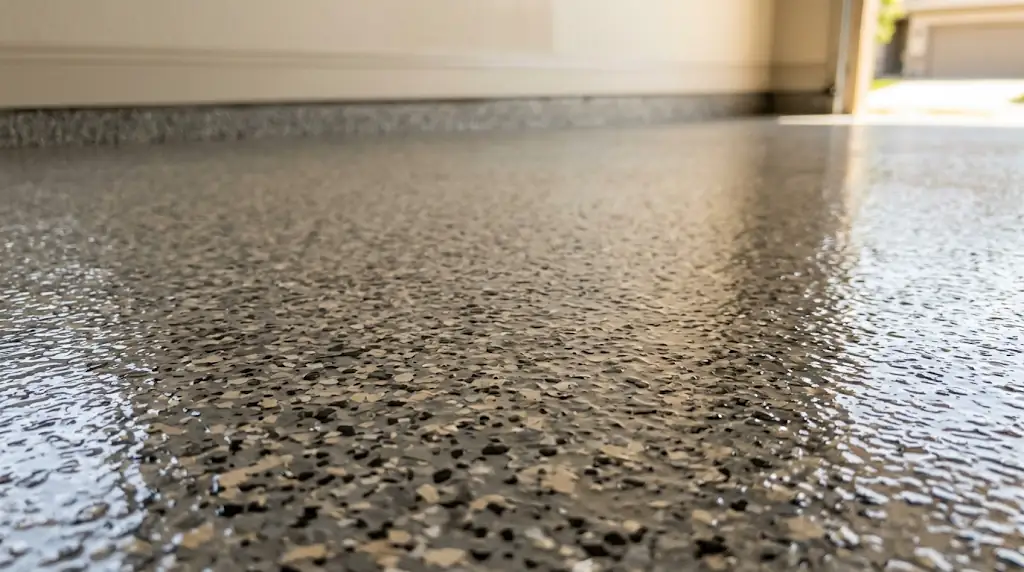
- Full Flake Broadcast: Decorative vinyl flakes are cast into the wet epoxy base coat to rejection (complete 100% coverage). The vinyl flakes provide impact resistance, hide slab imperfections, and create physical thickness.
- Aliphatic Polyaspartic Clear Topcoat: Once the base coat is set, excess flakes are scraped flat, and a pure polyaspartic topcoat is squeegeed and back-rolled across the surface. This layer serves as the sacrificial armor: heat-proof, UV-stable, chemical-resistant, and impervious to hot tire pickup.
Local Performance Considerations Across the East Valley
Concrete behavior varies across the region:
- Gilbert & Queen Creek: Predominantly post-tension slabs sitting over high-shrink clay. Requires elastic polyaspartic top layers to accommodate foundation movement.
- Chandler & Tempe: Established residential subdivisions with older slabs showing oil impregnation. Thorough mechanical grinding and moisture vapor epoxy primers prevent off-gassing issues before polyaspartic sealing.
- Scottsdale: Collector vehicles and sports cars with performance compound tires generate aggressive tire friction, demanding the superior Taber abrasion ratings of polyaspartic wear layers.
- Mesa & San Tan Valley: Large multi-car detached garages, workshops, and RV gates requiring high impact and chemical resistance against tool drops, welding sparks, and hot engine fluids.
Protect Your Garage Slab with the Right System
Standard epoxy cannot withstand the extreme thermal spikes, UV exposure, and tire temperatures common to Phoenix East Valley summers. Utilizing a commercial hybrid system—combining a deep-penetrating epoxy primer with a heavy-duty aliphatic polyaspartic topcoat—ensures your garage floor will not peel, yellow, or blister under extreme desert conditions. To inspect your concrete slab, review custom flake textures, and receive an upfront estimate, visit our contact page to connect directly with the team at Gilbert Epoxy Flooring.