The best commercial epoxy floor coatings for Phoenix East Valley businesses are 100% solids epoxy mortar systems, heavy-duty quartz-broadcast broadcast systems, and urethane cement slurries capped with high-wear aliphatic polyaspartic topcoats. The optimal coating specification depends entirely on operational demands: urethane cement provides critical thermal-shock resistance for commercial kitchens and food processing facilities, full-broadcast quartz systems deliver non-slip durability for medical and educational environments, and thick 100% solids epoxy high-build systems withstand heavy forklift traffic in industrial warehouses.
Commercial Flooring Systems: Facility Selection Matrix
Commercial facilities operate under diverse physical, chemical, and sanitary requirements. The table below details recommended resin configurations based on industry applications across Maricopa and Pinal counties:
| Facility Type | Recommended Resin System | Target Dry Film Thickness (DFT) | Key Performance Attribute | Applicable Regulatory Standards |
| Commercial Kitchens & Breweries | Heavy-duty urethane cement slurry with cove base | 3/16″ – 1/4″ (180–250 mils) | Extreme thermal shock (-40°F to 240°F) & organic acid resistance | Maricopa County Environmental Services Dept. (MCESD) / FDA Food Code |
| Auto Service Centers & Hangars | 100% solids epoxy base with dual polyaspartic clear cap | 30 – 40 mils | Skydrol, brake fluid, and hot-tire pickup resistance | High compressive strength (>9,000 psi) |
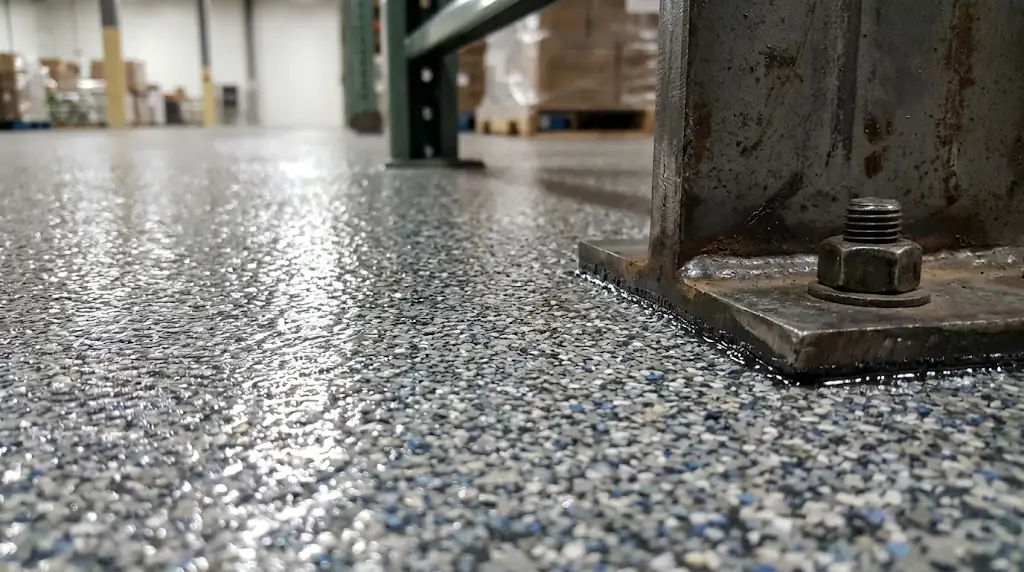
| Warehouses & Logistics Hubs | High-build 100% solids epoxy with aluminum oxide grit | 20 – 30 mils | Continuous forklift shear and high-load traffic | ASTM D4060 Taber abrasion standards |
| Medical Clinics & Cleanrooms | Seamless double-broadcast color quartz system | 1/8″ (125 mils) | Monolithic, antimicrobial, non-porous pinhole-free finish | USP 797/800 cleanroom compliance |
| Retail Showrooms & Offices | Designer metallic epoxy or full-flake hybrid | 25 – 35 mils | High-gloss reflectivity, aesthetic design, easy sanitation | Low-VOC compliance |
3 Proven Commercial Coating Formulations
Off-the-shelf consumer or light residential products will rapidly fail under the weight, chemical exposure, and continuous duty cycles of a commercial operation. Commercial facilities require industrial chemical architectures:
1. Urethane Slurry Cement (Best for Commercial Kitchens & Beverage Plants)
Commercial kitchens in restaurants, breweries, and food production plants face hot water washdowns, boiling grease spills, and harsh antimicrobial caustic washes.
- Standard epoxy has a coefficient of thermal expansion drastically different from concrete. When scalded by 200°F wash water, rigid epoxy expands faster than the underlying concrete slab, leading to immediate blistering and shearing along the bond line.
- Urethane cement expands and contracts at the exact same rate as concrete. It withstands direct thermal shock from steam cleaning and hot water dumps while resisting animal fats, lactic acids, and bleach sanitizers.
- Installing an integral seamless 4-to-6-inch cove base creates a smooth water barrier up the wall, eliminating grout joints and meeting sanitation requirements enforced by the Maricopa County Environmental Services Department.
2. Double-Broadcast Quartz Epoxy (Best for High-Traffic Healthcare & Public Spaces)
For facilities with constant foot traffic and wet slip hazards—such as medical centers, veterinary clinics, schools, and gym locker rooms—double-broadcast quartz provides an extremely durable floor.
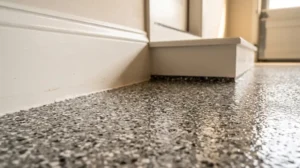
- Colored silica ceramic quartz grains are cast into two consecutive coats of clear 100% solids epoxy resin.
- The system builds an impact-resistant matrix up to 1/8-inch thick.
- When sealed with a chemical-resistant topcoat, the floor provides consistent slip-resistance under wet conditions while remaining fully cleanable, meeting accessibility and friction guidelines outlined under the Americans with Disabilities Act (ADA).
3. High-Build 100% Solids Epoxy + Polyaspartic Wear Cap (Best for Industrial & Automotive)
Light industrial manufacturing facilities, automotive repair shops, and aerospace hangars require high compressive strength and chemical impermeability.
- A high-solids epoxy primer penetrates diamond-profiled concrete, developing adhesion tensile strengths exceeding 400 psi in accordance with ASTM D4541 test methods.
- An aliphatic polyaspartic topcoat locks the surface. Polyaspartics resist aviation hydraulic fluids (such as Skydrol), battery acid, gasoline, and transmission fluid without hazing or softening.
- The cured topcoat provides a shore D hardness exceeding 80, deflecting metal wheel gouges, pallet jacks, and heavy steel fabrication drops.
Operational Priorities for East Valley Businesses
Commercial projects demand precise scheduling and safety considerations that differ from residential upgrades:
Rapid Cure Turnaround and Minimal Downtime
Closing a commercial facility for 5 to 7 days for a traditional floor cure costs businesses thousands of dollars in lost revenue. Utilizing fast-curing polyaspartic and polyurea systems allows companies to resume operations on an aggressive schedule:
- Heavy planetary diamond grinding completed overnight.
- System applied and cured to foot traffic in 4 to 8 hours.
- Full heavy equipment and forklift traffic returned in 24 to 48 hours.
Zero-VOC and Odor Control
For operating restaurants, healthcare centers, and corporate facilities in Tempe, Chandler, and Scottsdale, strong solvent odors are unacceptable. Commercial installations utilize 100% solids, zero-VOC (Volatile Organic Compound) chemistries that emit no hazardous vapors, allowing adjacent business offices and dining areas to operate safely without evacuation.
Dust Control During Surface Preparation
Mechanical planetary grinding to Concrete Surface Profile (CSP) 2 or 3 generates significant concrete dust. Commercial crews must utilize heavy industrial pulse-jet vacuums running certified HEPA filtration systems to ensure complete containment, adhering to strict OSHA respirable crystalline silica standards to safeguard employees, customers, and interior HVAC units.
Regional Commercial Growth Corridors in the East Valley
Flooring specifications match the regional commercial expansion occurring throughout local business districts:
- Chandler (Price Road Corridor): High demand for cleanroom-grade, anti-static electrostatic dissipative (ESD) epoxy systems in advanced electronics, semiconductor manufacturing, and tech assembly facilities.
- Mesa (Falcon Field & Gateway Airport Hubs): Large-scale aircraft hangars, defense contractors, and advanced machining workshops requiring high-reflectivity, Skydrol-resistant high-build polyaspartic floor systems.
- Gilbert (Heritage District & SanTan Village): Busy culinary destinations and retail storefronts requiring thermal-shock-proof urethane cement and decorative custom flake systems that handle heavy customer foot traffic.
- Tempe (Industrial & University Districts): Rapid turnaround coatings for distribution centers, multi-tenant warehouses, and commercial service centers near major arterial distribution hubs.
- Scottsdale (Airpark & Old Town): Luxury automobile dealerships, boutique retail showrooms, and high-end fitness facilities requiring high-gloss designer metallic epoxy and custom-color quartz floors.
- Queen Creek & San Tan Valley: Rapidly expanding retail strips, commercial strip plazas, and light contractor yards requiring durable, cost-effective exterior walkways and interior shop coatings.
Protect Your Commercial Facility with Industrial Coatings
A peeling, unsealed concrete floor damages operational efficiency, creates dust hazards, and violates sanitary standards. Installing a custom-engineered commercial epoxy, quartz, or urethane slurry system gives your business an impermeable, easy-to-clean floor designed to survive decades of heavy machinery, chemical spills, and continuous traffic. To assess your facility’s square footage, review chemical resistance specifications, and receive a clear commercial proposal, visit our contact page to consult directly with the commercial team at Gilbert Epoxy Flooring.