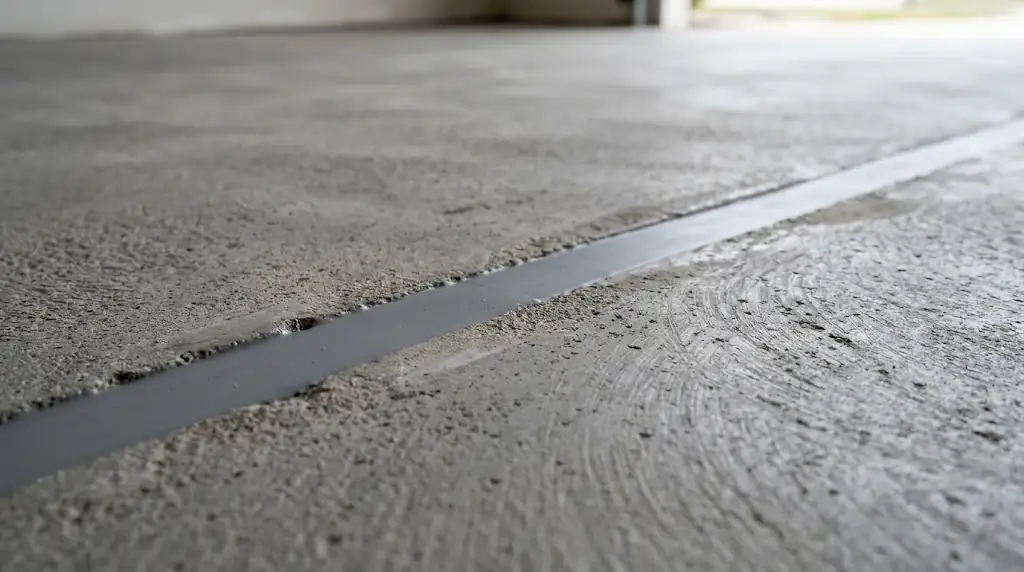
To repair and seal cracked concrete before applying epoxy in the Phoenix East Valley, technicians mechanically chase every crack using a diamond crack-chasing blade, extract all pulverized debris with HEPA dust-containment systems, and inject a rapid-curing, low-viscosity polyurea or hybrid structural epoxy mender. Rigid hardware-store hydraulic cements and caulk will fail; proper repair requires structural menders that bridge tensile loads and grind flush with the slab to establish an uninterrupted Concrete Surface Profile (CSP) 2 to 3 prior to basecoat priming.
East Valley Concrete Crack Repair Matrix
Concrete slabs experience different types of stress fractures depending on slab construction, age, and ground movement. The table below details how various crack types are prepared and repaired before coating:
| Crack Type | Typical Width | Root Cause in East Valley | Mechanical Preparation Method | Structural Repair Compound | Surface Leveling Finish |
| Hairline Micro-Fissures | < 1/16 inch | Plastic shrinkage during initial cure; desert evaporation | Planetary diamond grinding (CSP 2/3) | Ultra-low viscosity polyurea flood mender | Grinds completely flush with aggregate |
| Settling / Clay Shift Cracks | 1/16 to 1/4 inch | Expansive clay subsoil swelling and shrinking | 4.5″ angle grinder with “V”-blade diamond wheel | High-elongation polyurea or structural epoxy mender | Scraped flush after 15-minute gel |
| Control / Saw-Cut Joints | 1/8 to 3/8 inch | Intentional slab relief cuts | Diamond blade joint-cleaner and wire wheel | Flexible polyurea joint filler (or leave honor-cut) | Shaved flat with razor scraper |
| Spalled Pits & Aggregate Pop-Outs | 1 to 4 inches wide | Delamination beneath tire lines, dropped heavy tools | Diamond cup grinding down to solid aggregate | Fumed silica mixed with 100% solids epoxy mortar | Feathered and cross-ground |
| Heaved / Offset Slabs | Height mismatch > 1/8 inch | Severe subgrade moisture differential / uncompacted fill | Aggressive diamond scarifying / PCD scraping | Structural stitch pins + high-strength polymer | Planed flat with coarse 16-grit tooling |
The East Valley Soil Challenge: Why Slabs Crack Here
Cracking in Gilbert, Queen Creek, Mesa, Chandler, and San Tan Valley is rarely a cosmetic fluke; it is driven by geotechnical forces beneath the garage foundation.
1. Expansive Smectite Clay Formations
Much of the East Valley basin sits on deep alluvial deposits containing high concentrations of expansive clay minerals. According to geologic hazards documentation from the Arizona Geological Survey (AZGS), expansive soils across Maricopa and Pinal counties undergo dramatic volume changes when moisture levels fluctuate.
- Monsoon Swelling: During heavy summer storms, rainwater runoff seeps beneath garage footings and slab perimeters, causing the dry clay to expand aggressively.
- Desert Shrinkage: Prolonged 115°F summer heat dries out the perimeter soil, causing the clay to desiccate and shrink away from foundation edges.
- The Structural Result: The garage slab flexes under this continuous upward and downward movement, creating diagonal stress fractures, control-joint spalling, and vertical displacement.
2. High-Strength Post-Tension Slabs
Most modern homes in communities like Morrison Ranch (Gilbert), Eastmark (Mesa), and Fulton Ranch (Chandler) are engineered on post-tension (PT) cable foundations.
While PT slabs provide exceptional structural rigidity against soil movement, they exist under intense internal compressive tension. When a shrinkage crack or cold-pour joint does open, standard non-structural sealants cannot resist the shear forces along the fracture.
Why Consumer Crack Repair Products Fail
Homeowners frequently attempt to patch garage floor cracks with off-the-shelf hardware store materials before rolling on DIY paint:
- Hydraulic Cement and Concrete Patch: These products are rigid, non-flexible cementitious powders mixed with water. They possess virtually zero tensile adhesion. When the slab undergoes seasonal thermal expansion or soil movement, the patch shears along the bond line and pulverizes into powder beneath the coating.
- Silicone and Polyurethane Caulk: While flexible, caulks contain silicone oils and plasticizers that create an impermeable chemical barrier. Epoxy resin cannot bond to silicone; the coating will slide off the repair joint, leaving visible, sticky lines across the floor.
- Latex-Based Levelers: Water-based acrylic levelers lack compressive strength. Under the weight of a 5,000-pound truck or SUV, they crush, causing the overlying epoxy film to crack and flake.
The 5-Step Professional Repair Protocol
To ensure garage floor cracks never mirror through a finished epoxy or polyaspartic coating, installers follow a rigid mechanical repair procedure adhering to International Concrete Repair Institute (ICRI) substrate standards:
Step 1: Mechanical Crack Chasing
Hairline cracks cannot simply be painted over. A technician routes every visible fissure using a handheld angle grinder equipped with a specialized V-shaped diamond crack-chasing blade. Routing widens the top of the crack to approximately 1/4 inch, exposing clean, uncontaminated aggregate and removing micro-fractured concrete edges.
Step 2: High-Velocity Dust & Debris Evacuation
Routing generates fine crystalline silica dust. Technicians utilize industrial vacuum extractors operating under OSHA Respirable Crystalline Silica Standards to completely vacuum the fracture walls. Any residual concrete dust left inside the groove acts as a bond breaker, preventing the repair resin from welding to the concrete matrix.
Step 3: Low-Viscosity Polyurea Injection
The routed channel is filled with an ultra-low viscosity, two-component polyurea crack mender.
- Unlike thick pastes, low-viscosity polyurea has a water-like consistency when first mixed.
- Capillary action pulls the resin deep into the crack, penetrating several inches into the slab.
- The polyurea chemically cross-links within 10 to 15 minutes, developing compressive strengths exceeding 4,000 psi—making the repaired joint stronger than the surrounding concrete.
Step 4: Aggregate Fortification for Wide Voids
For wide spalls, trenches, or broken joint edges, technicians blend 100% solids epoxy or polyurea resin with kiln-dried industrial silica sand. This creates a dense, non-shrinking polymer mortar that rebuilds lost concrete volume without cracking or slumping.
Step 5: Flush Diamond Planing
Once the polyurea mender cures hard, excess material sits slightly proud of the floor. Technicians grind the joint completely flat using heavy planetary diamond floor grinders. This removes high spots and blends the repaired fissure directly into the overall CSP 2 or CSP 3 anchor profile of the concrete.
Treating Control Joints: Fill vs. Honor
A common question among East Valley homeowners is whether saw-cut control joints should be filled seamless or left open:
- Seamless (Filled Joints): Joints are filled with semi-rigid polyurea and ground completely flat before coating. This creates a monolithic, seamless showroom finish that prevents dirt, dust, and insects from accumulating in joint lines. (Recommended for stable, fully cured slabs over 1 to 2 years old).
- Honored (Open Joints): The coating is rolled down into the joint, and a flexible backing rod and polyurethane joint sealant are installed flush after the coating cures. This is ideal for active slabs experiencing continuous ground heave, allowing the concrete to move along designated relief points without stressing the floor finish.
East Valley Regional Substrate Considerations
- Gilbert & Queen Creek: High prevalence of expansive agricultural clays requires ultra-fast polyurea menders with higher elongation properties to absorb cyclic ground swelling.
- Mesa & Tempe: Established mid-century subdivisions frequently display structural cracking caused by historic tree root intrusion or eroded subgrades, requiring deep structural resin injection.
- Scottsdale & Paradise Valley: Custom properties featuring large clear-span garages require meticulous laser leveling across ground crack lines before applying metallic or high-gloss showroom coatings.
- San Tan Valley: Unpaved road dust and loose caliche require aggressive vacuum extraction along all routed joints to prevent unbonded resin failures.
Restore Cracked Concrete with Commercial Precision
Epoxy flooring is only as stable as the concrete beneath it. Covering up unrouted cracks with cheap caulk guarantees premature surface failure, while industrial diamond-chasing and high-strength polyurea injection weld your slab into a smooth, structurally sound foundation. To inspect your garage floor cracks, evaluate slab settling, and review custom flake options, visit our contact page to arrange an on-site concrete assessment with Gilbert Epoxy Flooring.