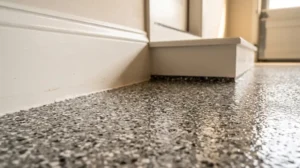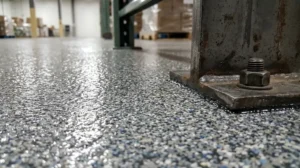
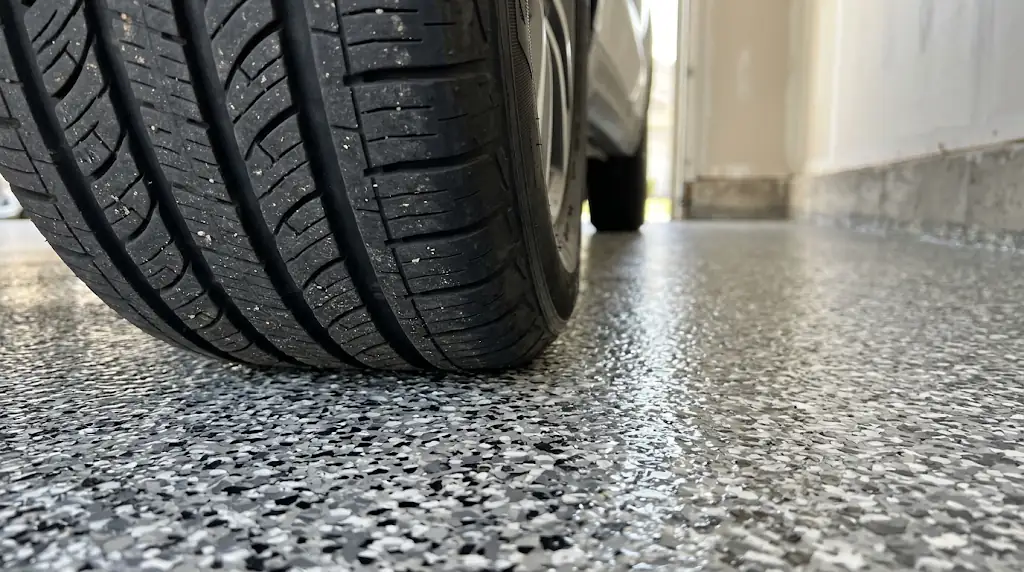
East Valley garage floors suffer from hot tire pickup because desert asphalt temperatures exceeding 160°F heat vehicle tires to extreme levels, which softens weak or poorly bonded epoxy coatings and allows cooling tire tread to mechanically pull the resin off the concrete slab. Fixing hot tire pickup requires mechanically grinding away the failed coating, profiling the concrete to an ICRI CSP 2 or 3 standard, and installing a multi-layer system capped with a heat-resistant, high-crosslink polyaspartic clear coat.
The Chemical and Thermal Physics of Hot Tire Delamination
Hot tire pickup is not an aesthetic surface stain; it is a mechanical and chemical bond failure. The delamination occurs through a three-stage sequence:
- Thermal Softening: Standard consumer-grade epoxies have low glass transition temperatures ($T_g$), typically between 120°F and 130°F. When tires heated by Arizona roads park on this resin, the coating rapidly warms past its threshold, causing the polymer chains to relax and soften.
- Plasticizer Migration: Automotive tires contain synthetic polymers and chemical plasticizers engineered to maintain tread flexibility. At elevated temperatures, these plasticizers leach out of the tire rubber and chemically fuse into the softened epoxy surface.
- Contraction Pull: As the parked vehicle sits overnight, the tires cool and contract. The tire rubber tightens its grip on the chemically fused coating. When the vehicle reverses out of the garage, the sheer tensile pull of the tire exceeds the coating’s adhesion to the concrete, stripping the resin directly off the slab.
According to adhesion parameters established in ASTM D4541 test standards, industrial floor coatings require a minimum bond strength of 300 to 400 psi to prevent mechanical delamination. Low-solids DIY paints provide less than 150 psi, failing well before the tire’s pulling force dissipates.
Why the Phoenix East Valley Is Ground Zero for Tire Pickup
Climatic conditions and infrastructure throughout Maricopa and Pinal counties create an ideal environment for coating failures. Data recorded by the National Weather Service Phoenix Forecast Office reveals that the region experiences sustained summer daytime highs between 110°F and 118°F, creating extreme roadway conditions:
- 170°F Roadway Surfaces: Dark asphalt on high-speed regional corridors like Loop 202 (Santan Freeway), US 60 (Superstition Freeway), and Arizona Avenue acts as a massive thermal reservoir. Surface road temperatures frequently reach 160°F to 175°F by late afternoon.
- Extended Highway Commutes: East Valley commuters driving 20 to 45 minutes home from downtown Phoenix, Scottsdale, or Sky Harbor Airport subject their tires to continuous high-speed friction. Tires retain internal casing temperatures above 140°F when pulling into residential driveways.
- Closed-Garage Heat Trapping: Garages throughout Gilbert, Mesa, and Chandler act as thermal ovens. When a hot vehicle enters a closed garage during July or August, ambient interior temperatures remain trapped above 105°F for hours, preventing tires and floor surfaces from cooling down quickly.
Coating Systems Compared: Hot Tire Resistance Matrix
Different resin chemistries react differently to hot Arizona tires. The table below outlines how standard formulations perform:
| Coating Chemistry | Max Temperature Resistance | Plasticizer Fusion Risk | Average Bond Strength (Concrete) | Hot Tire Failure Rate (East Valley Summers) |
| Water-Based DIY Epoxy Paint (1-part) | Under 120°F | High (Severe softening) | < 150 psi | 90%+ within Year 1 |
| Solvent-Based Retail Epoxy Kit (2-part) | 130°F – 140°F | High (Frequent softening) | 150 – 225 psi | 65% within Years 1–2 |
| 100% Solids Commercial Epoxy | 180°F – 200°F | Moderate (If topcoat is omitted) | 350 – 450 psi | Low (Basecoat only) |
| Aliphatic Polyaspartic Coating | 300°F – 350°F | None (Zero chemical migration) | 400 – 500+ psi | Zero (Impervious to tire heat) |
How to Permanently Fix a Floor Ruined by Hot Tire Pickup
Once an epoxy coating delaminates beneath tire contact points, spot patches will not work. Patching new resin over poorly bonded paint creates an uneven surface that will fail at the perimeter. The slab requires complete mechanical restoration.
Step 1: Complete Mechanical Stripping and Profiling
Muriatic acid washing will not remove old epoxy or open concrete pores correctly. The entire floor must be stripped using commercial planetary diamond grinders equipped with 16-to-30 grit diamond tooling.
Contractors must profile the bare concrete to Concrete Surface Profile (CSP) 2 or 3 standards as defined by ICRI Technical Publications. This removes dead concrete laitance, eliminates rubber tire residue, and carves microscopic anchor profiles into the solid concrete matrix.
Step 2: Elastomeric Polyurea Joint & Divot Repair
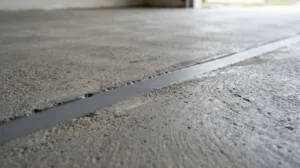
Tire delamination often rips away small chunks of surface aggregate. These divots, along with moving expansion joints, must be filled using a fast-setting polyurea repair mender. Rigid fillers like hydraulic cement or standard silicone crack caulk will fail under thermal expansion and cause future surface peeling.
Step 3: 100% Solids Deep-Penetrating Primer
A high-solids epoxy or polyurea basecoat is flooded over the profiled slab. Because 100% solids contain zero water or evaporating solvents, 100% of the liquid resin remains in the concrete pores, forming microscopic mechanical “roots” that physically lock into the open CSP 2/3 profile.
Step 4: Full Broadcast Vinyl Flake Layer
Decorative polymer flakes are broadcast into the wet primer until the floor is completely rejected (zero wet spots visible). This layer adds structural thickness (roughly 35 to 40 mils), absorbs vehicle impact, and distributes thermal contact loads across a larger surface area.
Step 5: Aliphatic Polyaspartic Chemical Armor
After the excess flake is scraped flat, an aliphatic polyaspartic clear coat is squeegeed and back-rolled across the surface.
- Polyaspartic resins feature an ultra-dense molecular cross-link structure.
- The cured topcoat withstands heat spikes up to 300°F+ without softening.
- The material does not contain reactive sites that allow tire plasticizers to bond.
- Tires sit entirely on an impermeable, heat-shielded wear layer.
Best Practices for East Valley Garages
To extend floor longevity across regional communities:
- Never Use Acid Etching on Hard-Troweled Concrete: Subdivisions in Gilbert (Power Ranch, Val Vista Lakes), Chandler (Ocotillo), and Queen Creek contain dense machine-troweled concrete. Acid etching only washes the surface without creating the mechanical profile needed for chemical bonding.
- Park Outside During Initial Cure: When installing a new hybrid or polyaspartic system, allow the topcoat a full 24 to 48 hours before parking vehicles on the surface, especially during summer heatwaves.
- Keep Tire Air Pressure Balanced: Underinflated tires generate significantly higher rolling temperatures along the Loop 202 and US 60 corridors, creating hotter contact patches inside the garage.
Eliminate Hot Tire Peeling for Good
Hot tire pickup is the direct result of using materials that cannot handle the thermal realities of the Sonoran Desert. Applying commercial-grade surface profiling and heat-tolerant polyaspartic finishes ensures your garage floor will not soften, lift, or peel away when your car parks for the night. To inspect your existing garage floor, remove failed DIY coatings, and install a heat-resistant commercial system, visit our contact page to arrange an on-site concrete assessment with Gilbert Epoxy Flooring.