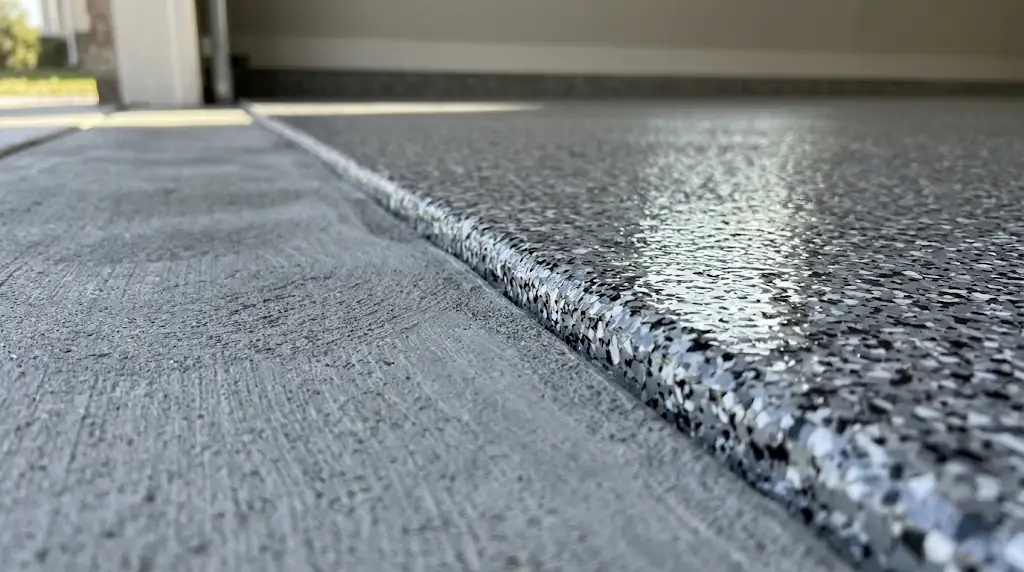
DIY garage floor epoxy is not worth the investment for Phoenix East Valley homeowners because over 70% of retail kit installations fail within the first two desert summers. Hardware-store kits rely on weak water-based formulas and chemical acid etching that cannot properly profile hard-troweled Arizona concrete, leading to widespread peeling, yellowing, and hot tire pickup when summer garage temperatures surpass 110°F.
DIY Kits vs. Professional Floor Systems: Side-by-Side Comparison
Consumer retail kits appear economical on the shelf, but their material specs and mechanical bond strengths fall far short of commercial installations:
| Specification | Retail DIY Epoxy Kits | Professional Multi-Layer System |
| Resin Solids Content | 40% – 50% (water- or solvent-diluted) | 100% Solids Epoxy + Aliphatic Polyaspartic |
| Dry Film Thickness (DFT) | 2 – 4 mils (paper-thin) | 30 – 40 mils (industrial armor) |
| Concrete Surface Preparation | Muriatic or citric acid washing | Heavy mechanical planetary diamond grinding |
| Concrete Surface Profile (CSP) | CSP 0 – 1 (smooth, closed pores) | CSP 2 – 3 (open, textured anchor profile) |
| Hot Tire Heat Resistance | Fails at 120°F – 130°F | Resists thermal loads up to 300°F+ |
| UV Sunlight Stability | Ambers and hazes within 6–12 months | 100% aliphatic UV-stable clear shield |
| Average Functional Lifespan | 1 to 3 years in Arizona | 15 to 20+ years |
| Typical 5-Year True Cost | $1,800 – $2,800 (includes removal) | $2,400 – $4,200 (one-time investment) |
Why DIY Epoxy Kits Fail in the East Valley
The gap between DIY epoxy marketing claims and real-world performance is widest in hot, arid desert climates. Three critical failure mechanisms break down retail kits:
1. Acid Etching Cannot Open Hard Arizona Slabs
Retail kits include small packets of citric acid or recommend muriatic acid washes to prepare the floor. Acid etching relies on a chemical reaction to dissolve the slick top layer of cement paste (laitance).
- The Problem: Modern home slabs across Gilbert, Chandler, and Queen Creek are poured with dense, high-strength concrete and power-troweled until glass-smooth.
- The Result: Acid washes pool on the surface without penetrating. They cannot open the slab’s microscopic pores or create a mechanical anchor. When the watered-down paint cures on this unprofiled concrete, it sits like a sheet of plastic wrap on glass—delaminating the first time weight is applied.
According to surface preparation benchmarks established by the International Concrete Repair Institute (ICRI), industrial coatings require a minimum Concrete Surface Profile of CSP 2 or CSP 3. This profile can only be achieved with commercial planetary diamond grinding equipment equipped with heavy magnetic diamond tooling.
2. Evaporating Solvents Leave a Thin, Fragile Film
Retail garage floor kits contain 40% to 50% water or chemical solvents.
- As the kit cures, the water or solvent evaporates into the air.
- What remains behind is a microscopic resin layer measuring only 2 to 4 mils thick (roughly the thickness of a piece of paper).
- A single dropped wrench, rolling floor jack, or dragging patio chair gouges straight through the thin film to bare concrete.
In contrast, professional installers use 100% solids epoxy combined with a full broadcast of vinyl flakes and a heavy polyaspartic topcoat. Because 100% solids contain zero evaporating thinners, 100% of the wet material stays on the floor, producing an ultra-dense barrier 30 to 40 mils thick.
3. Thermal Softening and Plasticizer Migration
East Valley asphalt regularly hits 160°F to 175°F during summer heatwaves. When a car drives home across the Loop 202 or US 60 and pulls into a closed garage, internal tire temperatures transfer directly to the concrete.
Consumer epoxy soft-sets under these thermal loads. The tire’s synthetic polymers and rubber plasticizers chemically fuse into the hot resin. When you back your car out the next morning, the cooled tire pulls the cheap paint straight off the floor.
The Hidden Costs of a “Cheap” DIY Project
Many homeowners tackle garage flooring to save money, but DIY failures carry high remediation costs.
Purchase Retail Kits & Rollers ($400 - $650)
  └──> First Summer Heat Wave Strikes
        └──> Hot Tires Tear Coating Off Floor (Hot Tire Pickup)
              └──> Professional Hired to Fix It
                    └──> Pay $2.00 - $3.00/sq. ft. Extra for Chemical/Mechanical Stripping
                          └──> Total Spend Ends Up Double the Original Professional Quote
The Cost of Failed DIY Remediation (450 sq. ft. 2-Car Garage)
- Initial DIY Spend: $500 for retail kits, acid wash, tape, and rollers.
- Personal Labor: 15 to 20 hours spent sweeping, acid washing, mixing, and rolling.
- Coating Removal: Failed, tacky, or half-peeled DIY epoxy clogs diamond grinding discs. Contractors charge a $2.00 to $3.00 per square foot remediation fee to remove failed resin before installing a new floor ($900 to $1,350 in grinding fees alone).
- Final Professional Replacement: $2,400 to $3,500.
- Total Realized Cost: Over $3,800 to $5,350 to fix what was intended to be a weekend savings project.
What a Professional East Valley Installation Involves
Achieving an industrial-grade garage floor requires commercial equipment, safety gear, and specialized chemistry:
- Planetary Diamond Grinding: Heavy 220V planetary grinders open hard-troweled concrete, strip away old contaminants, and open capillary pores to CSP 2/3.
- HEPA Dust Containment: Industrial pulse vacuums capture airborne crystalline silica dust, meeting OSHA respirable silica standards to keep homes clean and families safe.
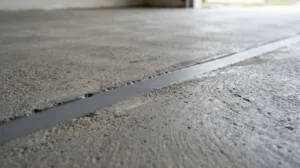
- Moisture & Crack Remediation: Expansive clay soils throughout Queen Creek, San Tan Valley, and Gilbert cause foundation settling. Moving control joints and hairline fissures are routed and filled with high-strength elastomeric polyurea menders.
- 100% Solids Epoxy Primer: High-solids base resin wicks deep into the diamond-profiled concrete matrix, forming an unbreakable mechanical root structure.
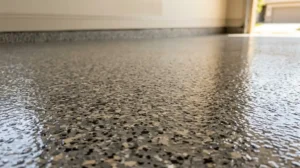
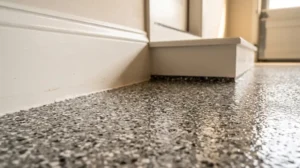
- Full Polymer Flake Broadcast: Flakes are cast to complete rejection, adding color, texture, slip resistance, and structural thickness.
- Aliphatic Polyaspartic Clear Coat: Squeegeed and back-rolled to lock the flakes into an impermeable wear layer that withstands tire heat up to 300°F+, prevents chemical staining, and resists UV yellowing.
The Verdict for East Valley Homeowners
DIY garage floor epoxy can work for low-traffic indoor utility closets or seasonal cottages in cool climates. However, for a working garage in Gilbert, Chandler, Mesa, Tempe, Scottsdale, Queen Creek, or San Tan Valley, DIY kits fail under extreme desert conditions.
Skipping proper diamond surface profiling and using low-solids paint creates an inevitable peeling problem that costs twice as much to undo later.
Install a Floor Built for the Arizona Heat
Skip the cycle of peeling DIY paints and costly strip-downs. Investing in a commercial hybrid system backed by mechanical diamond grinding gives you an industrial-grade finish that resists hot tires, vehicle fluids, and desert heat for decades. To evaluate your garage slab, inspect flake samples, and get an accurate upfront estimate, visit our contact page to arrange an on-site consultation with Gilbert Epoxy Flooring.